
Whitfield Legal Group — Streamlined Client Intake
The Problem
This law firm client intake automation case study looks at Whitfield Legal Group, a small law firm handling family law and personal injury cases in a competitive US market, with three attorneys and a two-person support staff managing new client inquiries alongside active casework.
Like most small law firms, their growth depends almost entirely on converting initial inquiries into signed clients — but their conversion process was running almost entirely on manual effort. New inquiries arrived through several disconnected channels: phone calls, a website contact form, and referrals passed along informally by past clients.
Each required a staff member to manually log the inquiry, determine which practice area and attorney it belonged to, gather basic details, and schedule a consultation — all before the prospective client had any real commitment to the firm. Without law firm client intake automation handling this first step, the process depended entirely on staff availability. During busy weeks, this intake process was frequently delayed by a day or more, and inquiries submitted after hours or over weekends routinely sat unactioned until the following business day.
This delay carries real cost in legal services specifically. Prospective clients dealing with a personal injury or a family law matter are often contacting multiple firms simultaneously, comparing responsiveness as a proxy for how attentively their case will be handled. This pattern is well documented — research published in the Harvard Business Review found that firms attempting to contact a lead within an hour were nearly seven times more likely to qualify that lead than those waiting even 24 hours, with response delays of 24 or more hours cutting qualification odds by 60 times.
For Whitfield Legal Group, this translated to an estimated 8–12 lost potential client matters per month across their personal injury and family law caseloads. This represented a projected $15,000–$35,000 in lost monthly potential revenue — a wide range reflecting the significant variance in case value, but consistently substantial regardless of where in that range any given month landed. Beyond lost revenue, staff were also spending several hours per week on manual data entry and status tracking that added no real value to the client relationship itself, underscoring exactly the gap law firm client intake automation is designed to close.
The Automation Solution: Law Firm Client Intake Automation
We modeled a law firm client intake automation system using GoHighLevel, built to capture every inquiry the moment it arrives and move it toward a booked consultation without waiting on manual staff follow-up.
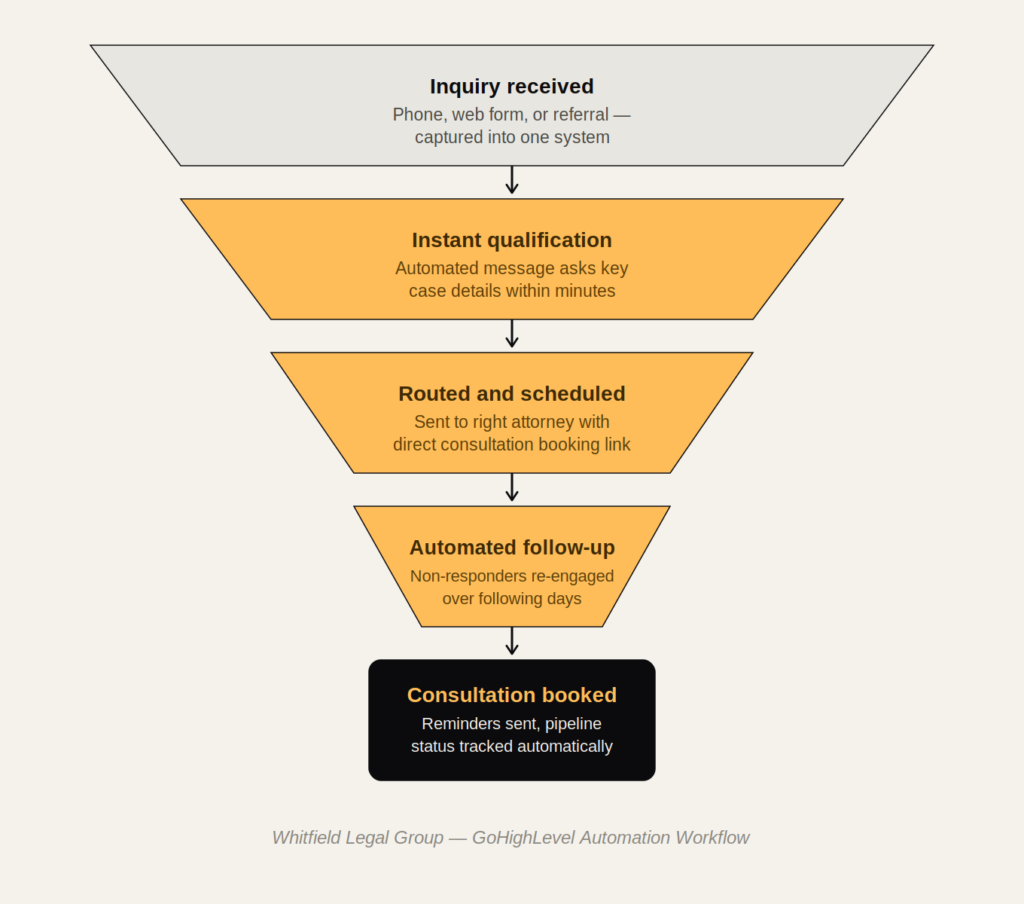
Every inquiry — whether it comes in by phone, through the website contact form, or as a referral — is captured into a single system instead of being scattered across disconnected channels. Within minutes of that inquiry landing, an automated message asks the key qualifying questions: practice area, case type, and preferred contact details.
Based on those answers, the system automatically routes the inquiry to the right attorney and sends the prospective client a direct link to book a consultation — no more waiting for a staff member to manually match the case to the right practice area.
If a lead doesn’t respond or book right away, an automated follow-up sequence re-engages them over the following days rather than letting the inquiry go cold. Once a consultation is booked, reminders go out automatically and the matter’s status is tracked in the pipeline without any manual data entry.
This shifted Whitfield Legal Group from a manual, easily-delayed intake process to a structured law firm client intake automation system — one where every inquiry gets a fast, consistent first response regardless of how busy the front office is that day.
This case study demonstrates how a GoHighLevel automation system can transform client intake for law firms — see our other GHL automation case studies for more examples.
Projected Outcome
These figures are modeled projections based on industry benchmarks for law firm client intake automation in small firms — not audited results from an actual Whitfield Legal Group deployment. They're intended to illustrate the realistic range of impact this type of automation typically delivers.
This isn’t a hypothetical upside — Clio’s 2024 Legal Trends Report found that law firms using client intake technology see 51% more leads and 52% higher revenue on average compared to firms still relying on manual intake.
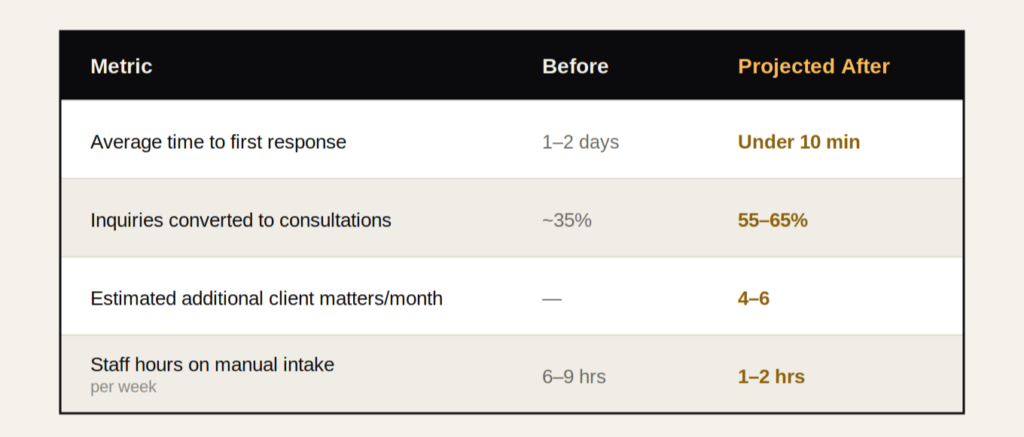
Figures are modeled projections based on industry benchmarks, not audited client results.